
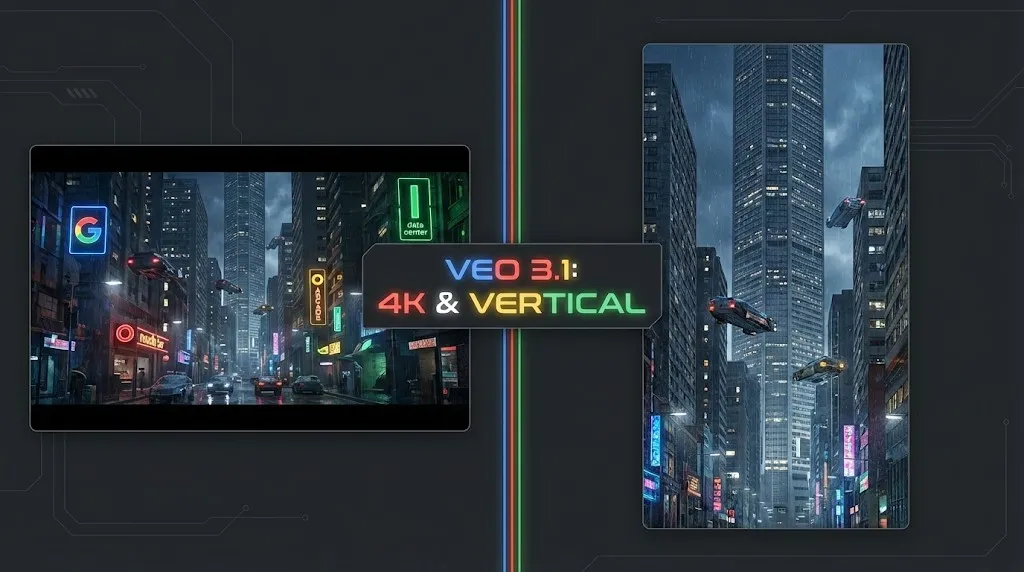
Google Veo 3.1 Review: The 4K, Vertical, and Consistent Video Revolution
Introduction
The AI video generation landscape has been plagued by three persistent challenges: resolution limitations, aspect ratio constraints, and character consistency issues. Google's Veo 3.1 addresses all three simultaneously, marking a significant milestone in the evolution of AI video technology.
Google Veo 3.1 represents Google's most ambitious video generation model to date, bringing native 4K resolution, 9:16 vertical video support, and groundbreaking identity consistency capabilities. These features collectively solve the most common pain points for content creators, filmmakers, and social media professionals.
In this comprehensive review, we will explore:
- How native 4K upscaling eliminates the need for external upscalers
- The impact of 9:16 vertical video on mobile-first content creation
- The revolutionary identity consistency engine for character locking
- A sneak peek at the leaked Veo 3.2 model code discovered by Bedros Pamboukian
The Clarity Revolution: Native 4K Upscaling
Breaking the Resolution Barrier
Previous AI video models typically maxed out at 1080p, requiring users to employ third-party upscalers to achieve 4K quality. Google Veo 3.1 changes this paradigm by offering native 4K output through its API, delivering unprecedented clarity and detail directly from the generation process.
Technical Implementation: The 4K capability is achieved through a multi-stage generation process that combines high-resolution latent diffusion with temporal coherence algorithms. Unlike simple upscaling, Veo 3.1's native 4K generation maintains consistent detail across frames, eliminating the artifacts and blurring that often plague post-processed upscaling.
File Size and Quality Considerations
One notable aspect of Veo 3.1's 4K output is the substantial file size. An 8-second 4K video can reach approximately 50MB, reflecting the high bitrate and quality preservation.
This file size indicates:
- High-quality compression: Efficient encoding that maintains visual fidelity
- Rich detail preservation: Minimal compression artifacts
- Professional workflow compatibility: Suitable for broadcast and cinematic applications
[!TIP] Optimizing 4K Workflow: When generating 4K content with Veo 3.1, consider your storage requirements and bandwidth limitations. The high-quality output comes with larger file sizes, so plan your storage strategy accordingly.
Mobile-First: Native 9:16 Vertical Generation
The End of Manual Cropping
For social media creators, the transition from landscape to vertical video has been a constant challenge. Traditional AI video generators primarily output 16:9 content, forcing creators to manually crop or use complex editing workflows to adapt content for platforms like TikTok, Instagram Reels, and YouTube Shorts.
Veo 3.1's 9:16 native support eliminates this friction by generating content specifically optimized for mobile consumption. The model understands vertical composition principles, ensuring that key visual elements remain centered and properly framed within the 9:16 aspect ratio.
Composition Intelligence
What sets Veo 3.1 apart is its understanding of vertical composition dynamics. The model automatically:
- Centers subjects within the vertical frame
- Optimizes text placement for mobile readability
- Maintains visual hierarchy in vertical space
This intelligent composition eliminates the guesswork from vertical content creation, allowing creators to focus on storytelling rather than technical adjustments.
The Holy Grail: Identity Consistency
Solving the Character Consistency Problem
One of the most challenging aspects of AI video generation has been maintaining consistent character identity across different shots and scenes. Previous models often struggled with facial features, clothing details, and overall appearance consistency, limiting their usefulness for narrative content.
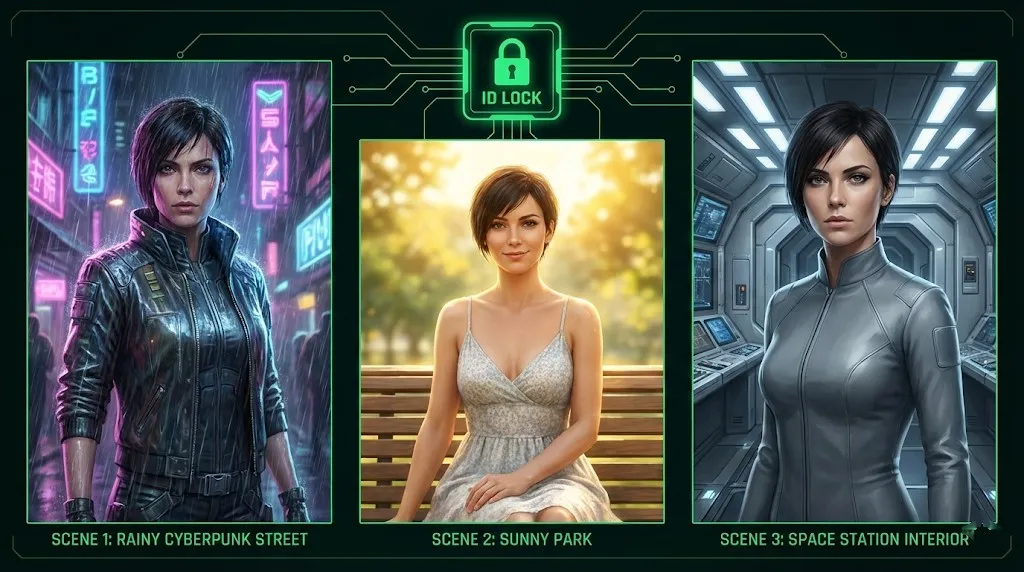
Veo 3.1's identity consistency engine introduces a breakthrough approach to this problem. By allowing users to upload multiple reference images of a character, the model can "lock" specific facial features, clothing elements, and physical characteristics across generated sequences.
How Identity Locking Works
The consistency system operates through key mechanisms:
- Multi-image reference processing: Users can upload multiple reference images (e.g., from different angles)
- Feature extraction and mapping: The model identifies and maps key facial landmarks
- Temporal coherence enforcement: Consistency is maintained across frames and scenes
This technology enables creators to:
- Generate multiple shots of the same character in different environments
- Maintain consistent appearance across different camera angles
- Create coherent narrative sequences with recurring characters
Workflow: From Static Image to 4K Vertical Video
End-to-End Production Pipeline
Combining Veo 3.1's three major features enables a streamlined production workflow that was previously impossible with AI video tools. Here's a theoretical workflow for creating professional vertical content:
Step 1: Character Preparation
- Gather high-quality reference images of your subject
- Ensure images show different angles and expressions
- Upload references to establish identity consistency
Step 2: Prompt Engineering
- Write detailed prompts including vertical composition cues
- Specify 4K resolution and 9:16 aspect ratio
- Include character consistency parameters
Step 3: Generation and Review
- Generate initial sequences
- Review for consistency and quality
- Make iterative improvements
Step 4: Final Output
- Export native 4K vertical video
- No additional upscaling or cropping required
- Ready for direct upload to social platforms
What's Next? A Sneak Peek at Veo 3.2
The Code Leak Discovery
While Veo 3.1 represents a significant advancement, evidence suggests Google is already working on the next iteration. Researcher Bedros Pamboukian recently discovered references to VIDEO_GENERATION_VE03 in Google's codebase, indicating active development of Veo 3.2.
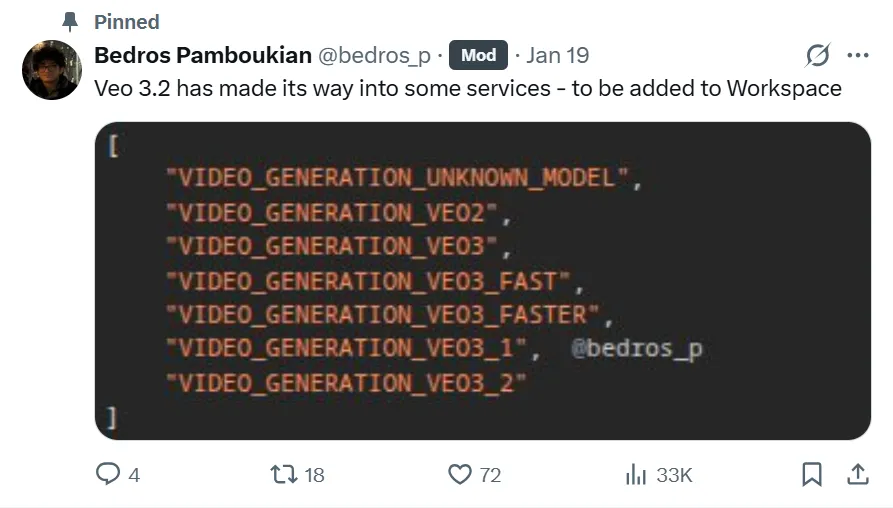
Source: Bedros Pamboukian via X
What We Know (and What We Don't)
The discovery of VIDEO_GENERATION_VE03 confirms that Google is continuing to invest heavily in video generation technology. However, it's important to distinguish between confirmed facts and speculation:
Confirmed Information:
- Google is actively developing a new video generation model
- The internal codename suggests it's the successor to Veo 3.1
- Development is ongoing as of the discovery date
Unknown Factors:
- Specific feature improvements or new capabilities
- Release timeline and availability
- Pricing structure and accessibility
Responsible Speculation
Based on Google's development patterns and the evolution from Veo 1.0 to 3.1, we can reasonably expect Veo 3.2 to focus on enhanced temporal coherence and improved efficiency. However, it's crucial to emphasize that these are educated guesses based on industry trends, not confirmed features.
Conclusion
Google Veo 3.1 represents a watershed moment in AI video generation technology. By simultaneously addressing resolution limitations, aspect ratio constraints, and character consistency issues, Google has created a tool that genuinely meets the needs of professional content creators.
Key Takeaways:
- Native 4K eliminates upscaling dependencies, providing broadcast-quality output directly from generation
- 9:16 vertical video support streamlines mobile content creation workflows
- Identity consistency solves one of the most persistent challenges in AI video
- The discovered Veo 3.2 code indicates continued rapid innovation in this space
For creators who have been waiting for AI video technology to mature enough for professional applications, Veo 3.1 may well be the turning point. As the technology continues to evolve, we can expect even more sophisticated tools to emerge. But for now, Veo 3.1 stands as the most comprehensive solution available for high-quality, consistent AI video generation.
Kling 3 4K vs Pro (1080p): When 4K Is Worth It-and When It's Not
A practical decision framework for choosing Kling 3 4K vs Pro (1080p): when 4K improves detail, motion, and compression-and when 1080p is the smarter default.
Kling 3 4K Workflow: Prompts, Shot Planning, and Export Settings That Actually Hold Up
A repeatable Kling 3 4K workflow to get usable deliverables: two-pass iteration, prompt templates, safe complexity rules, and export guidance to survive platform recompression.
Kling 3 Native 4K: What It Means for Quality, Motion, Compression, and Real-World Use
Learn what Kling 3 native 4K changes vs 1080p: sharper detail, cleaner motion, fewer artifacts, and when 4K is actually worth it.
HappyHorse AI Video Generator: What the New Model Can Do
Discover HappyHorse, a new AI video generation model with text-to-video, image-to-video, video-to-video, native audio, and creator-friendly workflows.
Wan 2.7 Image Meets Kling 2.6: The Ultimate AI Visual Workflow
Discover how the new Wan 2.7 Image model's advanced editing and 3K text rendering capabilities create the perfect asset pipeline for Kling 2.6 video generation.
The Next Generation of Generation: Unpacking the Wan 2.7 Upgrade
The highly anticipated Wan 2.7 Video release marks a turning point, introducing a multi-modal injection system and a studio-grade workflow for creators.
The Zero-Cost MoCap Studio: Mastering Kling 3.0 Motion Control for Extreme Action Physics
Master Kling 3.0 Motion Control for extreme action physics. Learn how to create cinematic combat choreography, parkour sequences, and VFX-grade animation without expensive motion capture suits.
Mastering Audio-Visual Sync: My Hands-On Guide to Kling Video 3.0 Omni
A comprehensive guide to Kling Video 3.0 Omni's Native Audio-Visual capabilities. Learn how to achieve accurate mouth movement AI, perfect lip-sync, and complex emotion reproduction for professional-grade AI video content.