

GLM-Image Review: The New King of Text Rendering?
GLM-Image Review: The New King of Text Rendering?
In a world dominated by Midjourney and Flux, Zhipu AI has quietly released a game-changer: GLM-Image. This Chinese text-to-image AI isn't just another image generator—it's a specialized tool that solves a long-standing problem in the AI art space: accurate text rendering, especially for Chinese characters.
The Hybrid Architecture Explained
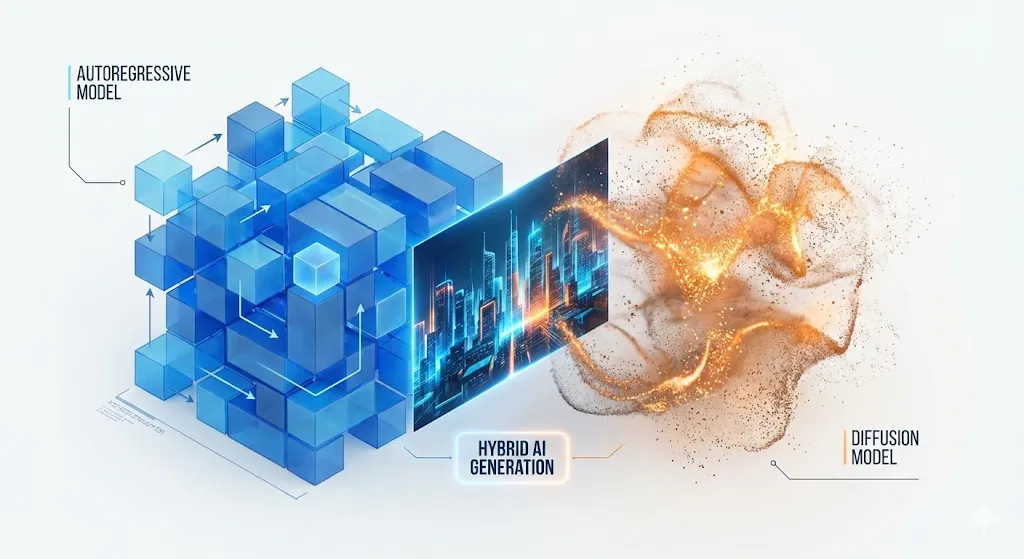
GLM-Image stands out from the crowd thanks to its innovative hybrid autoregressive diffusion model. Unlike pure diffusion models that struggle with text layout and accuracy, GLM-Image combines two powerful approaches:
- 9B Autoregressive Model: This component handles the structural aspects of image generation—layout, composition, and most importantly, text rendering. It acts like a creative director, planning where every element should go.
- 7B Diffusion Model: Once the layout is finalized, the diffusion model takes over to refine the details, textures, and overall visual quality.
This separation of powers is what makes GLM-Image 9B architecture so effective. The autoregressive model excels at understanding the precise placement of text, while the diffusion model ensures the final image looks polished and professional.
Text Rendering Test: Chinese vs English
The true test of any text-to-image AI is its ability to render text accurately. We put GLM-Image to the test by asking it to generate a restaurant poster with a complex Chinese menu.
The prompt was simple: "A modern restaurant poster with a detailed Chinese menu including dishes like Kung Pao Chicken, Mapo Tofu, and Sweet and Sour Pork. The text should be clear and readable."
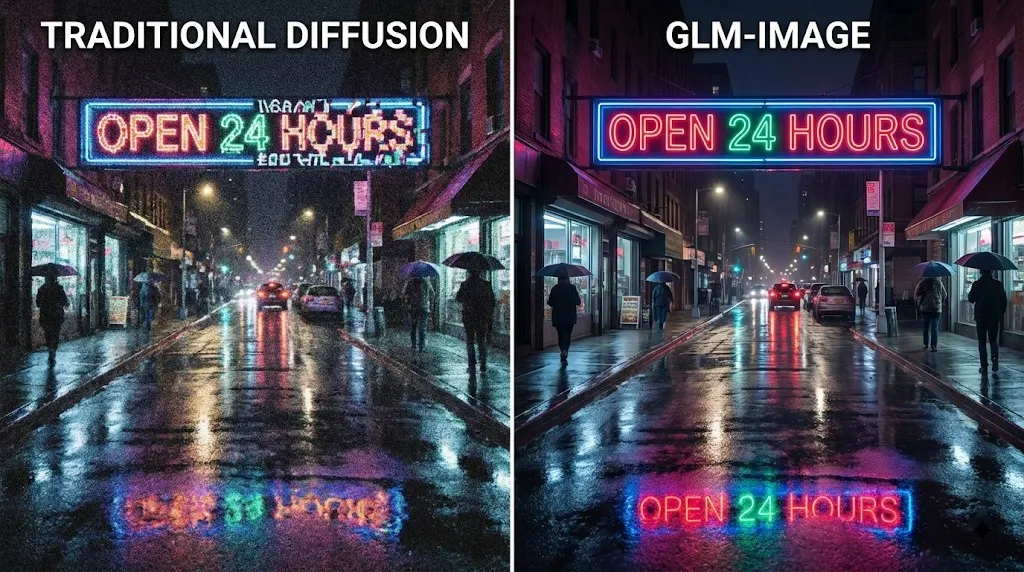
The result was stunning. GLM-Image generated a poster with perfectly rendered Chinese characters, each dish name clearly legible. In contrast, Midjourney V6 struggled to produce even basic Chinese text, often resulting in garbled characters or nonsensical combinations.
This is where GLM-Image text rendering capabilities truly shine. As a Chinese text to image AI, it understands the nuances of Chinese typography, spacing, and layout—something that foreign models have yet to master.
GLM-Image vs Midjourney & Flux
We compared GLM-Image with two of the most popular AI image generators on the market:
| Feature | GLM-Image | Midjourney V6 | Flux |
|---|---|---|---|
| Artistic Style | Functional, clean | Stunning, artistic | Balanced |
| Text Accuracy | Perfect | Poor | Average |
| Price | $0.014/image | $0.08/image | $0.03/image |
When it comes to GLM-Image vs Midjourney V6, the differences are clear. Midjourney excels at creating artistic, visually striking images, but it falls flat when it comes to text rendering. GLM-Image, on the other hand, prioritizes accuracy and functionality over artistic flair.
What Are Users Saying? (The Good & The Bad)
We scoured Reddit and Twitter to find out what real users are saying about GLM-Image:
The Good
- "Finally an AI that can spell! GLM-Image is a game-changer for poster design."
- "Perfect for marketing materials—no more manually adding text to AI-generated images."
- "As a Chinese user, I can finally create posters with readable Chinese text."
The Bad
- "Generation speed is slow, especially for high-resolution images."
- "The artistic style is a bit bland compared to Midjourney."
- "Limited customization options for text styles."
How to Use GLM-Image (API & Web)
Using GLM-Image is straightforward. You can access it through:
- Web Interface: Visit bigmodel.cn and sign up for an account. You can generate images directly through the web portal.
- API Integration: Use the Zhipu AI image generator API to integrate GLM-Image into your applications or workflows.
For users who want to run the model locally, you can download the GLM-Image 9B architecture and set it up on your own hardware. While this requires more technical expertise, it gives you full control over the generation process.
Pricing Verdict
One of GLM-Image's biggest advantages is its pricing. At just ~0.1 yuan per image, it's significantly cheaper than both Midjourney and Flux. This makes it an attractive option for businesses and designers who need to generate large numbers of images.
GLM-Image pricing and cost structure is designed for scalability. Whether you're a freelancer working on a small project or a large enterprise generating thousands of images, GLM-Image offers a cost-effective solution.
CogView-3 vs GLM-Image
Zhipu AI has a history of releasing powerful image models, including CogView-3. While CogView-3 is a strong model in its own right, GLM-Image represents a significant upgrade:
- Text Rendering: GLM-Image's hybrid architecture makes it far superior at rendering text, especially Chinese characters.
- Speed: GLM-Image is faster than CogView-3, even with its more complex architecture.
- API Access: GLM-Image offers more flexible API integration options, making it easier to use in production environments.
GLM-Image vs Qwen-Image-2512: Battle of the Giants
When discussing top-tier Chinese AI models, the conversation often creates a rivalry: GLM-Image vs Qwen-Image. specifically the high-resolution Qwen-Image-2512 model from Alibaba Cloud.
While Qwen (Tongyi Wanxiang) is an incredible generalist model known for its aesthetic versatility, benchmark data shows distinct differences in text rendering capabilities.
Benchmark Breakdown (CVTG-2K & LongText): According to recent open-source benchmarks comparing the two models:
- Word Accuracy: GLM-Image scores 0.9116, significantly outperforming Qwen-Image-2512's 0.8604.
- Chinese Text (LongText-Bench ZH): GLM-Image leads with 0.979, edging out Qwen's 0.965.
- Visual Fidelity (NED): GLM-Image achieves 0.9557, showing it doesn't sacrifice image structure for text accuracy.
The Verdict: If you need a "Jack of all trades" for artistic concepts, Qwen-Image-2512 is fantastic. However, if your priority is typographic precision—especially for commercial posters where a misspelled word ruins the print—GLM-Image is the statistically superior choice.
Best AI for Poster Design 2026?
With its combination of accurate text rendering, affordable pricing, and powerful features, GLM-Image is a strong contender for the title of best AI for poster design 2026. It's particularly well-suited for:
- Marketing Teams: Create posters, flyers, and other promotional materials with accurate text.
- Restaurants and Retailers: Generate menus, price lists, and product displays with readable text.
- Chinese Content Creators: Finally, an AI that understands Chinese typography.
GLM-Image Commercial License
For businesses looking to use GLM-Image in commercial projects, Zhipu AI offers flexible commercial license options. These licenses allow you to use the generated images for marketing, advertising, and other commercial purposes without any restrictions.
Conclusion
GLM-Image is a specialized tool that fills a unique niche in the AI art space. While it may not have the artistic flair of Midjourney, its text rendering capabilities are unmatched—especially for Chinese characters.
If you're a designer, marketer, or business owner who needs to create images with accurate text, GLM-Image is the perfect tool for you. Its hybrid architecture, affordable pricing, and powerful features make it a game-changer in the world of AI image generation.
So, is GLM-Image the new king of text rendering? Based on our tests, the answer is a resounding yes.
Seedance 2 Review: Is Jimeng 2.0 the End of "Gacha" AI Video?
Seedance 2 (Jimeng) is here with 4K resolution and revolutionary storyboard control. We test if Seedance2 finally solves the consistency problem for AI filmmakers.

PixVerse R1 Review: The First Real-Time Interactive AI World Model?
Hands-on review of PixVerse R1 real-time AI video generator. We test its 1080p streaming, infinite generation capabilities, and compare performance vs Runway Gen-3.

Kling 2.6 Deep Dive: Native Audio, Video Length & API Pricing Explained
Explore the new Kling 2.6 features including native audio and extended video length. We break down the pro model costs, API pricing, and how to start.
Veo 4 vs Seedance 2.1: Why the Next AI Video War May Be About Cost, Not Cinematic Quality
Seedance 2.1 is reportedly close, Veo 4 is widely expected around Google I/O, and Gemini Omni Flash has appeared inside Flow. The real question is no longer who looks most cinematic, but who lowers the cost of stable, usable output.
Seedance 2.1 May Be Coming Soon: Reported 20% Quality Gain, Cheaper Tier, and What Creators Should Watch
Seedance 2.1 is reportedly close to launch, with claims of a 20% quality improvement and a cheaper Seedance 2.0 tier. Here is what seems known, what is still unconfirmed, and why the update matters.
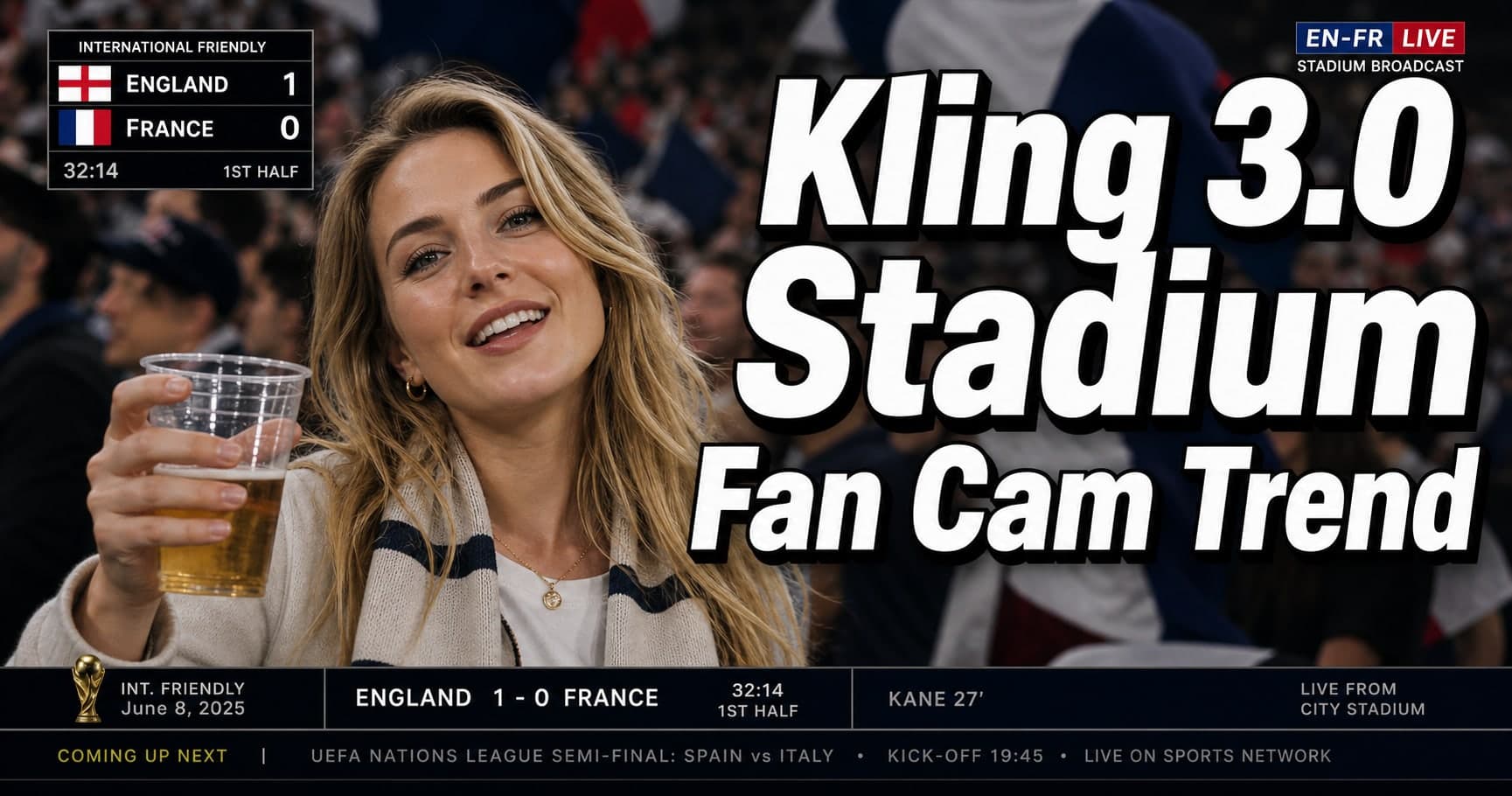
Kling 3.0 Stadium Fan Cam Trend: How to Prompt a Real Broadcast Look
A practical prompt blueprint for the Kling 3.0 stadium fan cam trend: broadcast realism cues, failure fixes, and a safe comparison plan.
Gemini Omni model: What It Is (and How to Build Safely While It’s Still Unclear)
A practical guide to the Gemini Omni model rumor cycle: what’s confirmed, what’s not, and how to ship video features safely using Veo 3.1 today.
Kling 3 4k Cost Routing
SEO-friendly description for search engines